
Road Construction Status
Road construction status.
Where the works have reached, how the road is being built, and what the corridor will look like when it opens.
Progress showcase
The corridor, as it stands.
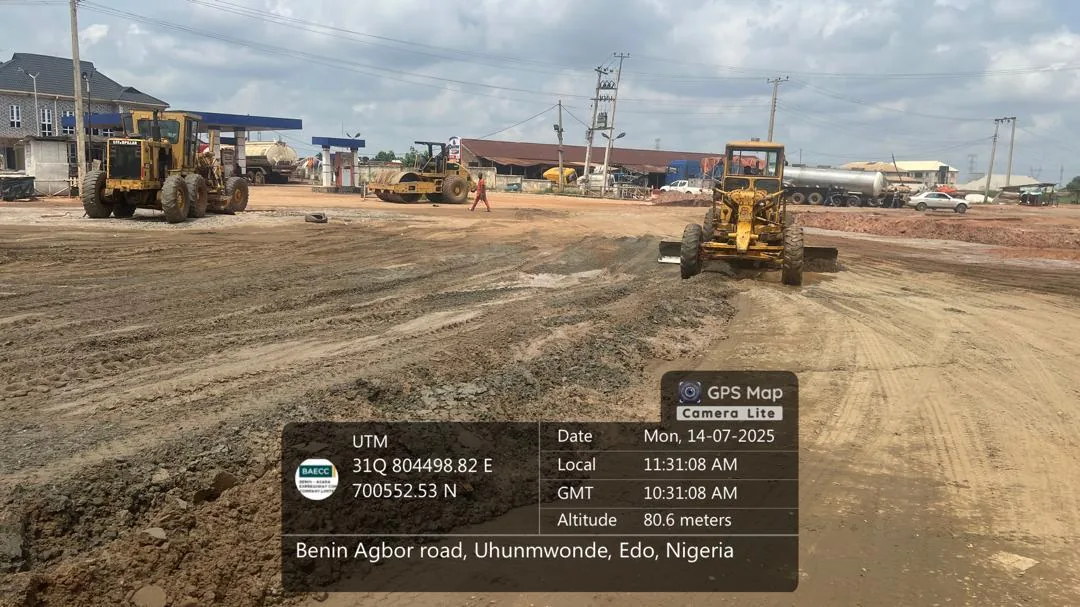
Photographs from the active work fronts and the project's own production facilities. Select any image to open the slideshow.
How the road is built
A pavement designed to outlast the concession.
The corridor is built to a design life of more than 20 years — longer than the concession term itself. Design was completed before construction began: topographic and geotechnical surveys, pavement design, bridge structural design, and traffic systems design are all issued.
Flexible pavement build-up
| Layer | Thickness | Notes |
|---|---|---|
| Bituminous wearing course | 4 cm | Applied over binder course with tack coat |
| Bituminous binder course | 6 cm | Laid over primed surface |
| Prime coat | — | 0.7–1.0 kg/m² over the sub-base |
| Granular sub-base | 15 cm | Granular material, no cement |
| Cement stabilised base | 15 cm | 3% cement, recycled and crushed material |
| Sub-grade | 15 cm min. | CBR above 15, plasticity index below 12 |
Rigid pavement
Where a concrete pavement is specified, a 20–25 cm pavement-quality concrete slab is laid over 15 cm of dry lean concrete, on the same granular sub-base and stabilised base build-up. Road marking follows the curing period, and road furniture is fixed to the highway manual.
Drainage by corridor character
Drainage is designed in three distinct configurations along the route, because a road through central Benin City does not drain like a road through rural Delta.
- Urban — km 0+000 to 2+500
- Semi-urban — km 54+000 to 61+000
- Rural — km 61+000 onward
Structures
- Ikopaba major bridge, km 3+400 — pile foundations, pre-stressed concrete girders and deck slab construction.
- Minor bridges — slab works, including at km 16+600, with approach slabs on both sides of every bridge.
- Pedestrian bridges — new construction on pylon and raft foundations.
- Vehicle underpasses — segment casing with reinforced earth walls on both sides.
Production capacity
We make our own materials.
Most road programmes in Nigeria stall waiting on third-party supply. This one produces its own asphalt, concrete and aggregate on site, and hauls them with its own fleet — so construction pace is governed by production capacity rather than market availability.
Operational
Concrete batching plant
On-demand concrete at the Bypass for toll plazas, drainage and pavement — removing dependence on external ready-mix.
Commissioning
Two asphalt plants
Dual plants sited at each end of the corridor. On-site production removes temperature degradation risk in transit and keeps the mix under our own quality control.
Operational
Crushing plant
Produces graded aggregate to specification with substantial stock held on site, removing haulage dependency for aggregate.
Deployed
50-truck logistics fleet
A captive haulage fleet for materials movement, so delivery to the work front does not queue behind third-party availability.
In production
Precast moulds
Drain units and New Jersey barrier forms produced in-house, eliminating external supplier lead times on these elements.
Secured
Materials supply
Granite allocation secured by advance deposit with quarry suppliers; bitumen dual-sourced from two independent suppliers; reinforcement steel ordered to programme.
Stay informed
Questions about the works near you?
If construction is affecting your community, your business or your route, we would rather hear from you than have you guess.